Jul 2016
From HAL to Pal
Our ancestors tamed vicious wolves into dogs. Now we must do the same with AI.
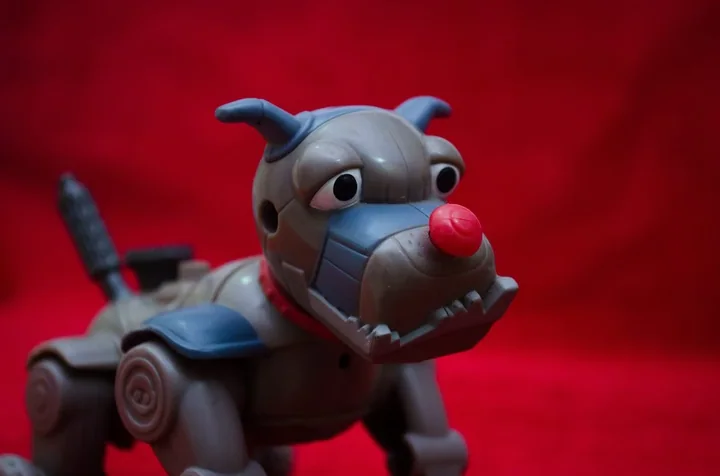
Was man’s best friend the first AGI?
Wolves into whippets

If a kind and gentle Golden Retriever suddenly reached human-level intelligence, would it be dangerous to you? It might unintentionally cause harm or alarm, but its intent would almost certainly be benign.
Dogs have emotion and personality. They miss people when they are not around, and we miss them greatly when they pass on.
Dogs have an enormously diverse genome thanks to millennia of human tinkering, and come in a staggering range of shapes and sizes. Our relationship with them is unlike that with any other creature; the cat and horse are fair-weather friends by comparison. Dogs and humans are tight like no other.
Through ongoing interaction with humans, domesticated dogs develop learned self-control resembling that of a very young child. Dogs can feel ashamed or embarrassed when scolded, and show anxiety to be forgiven. They must have some measure of internal self-control, imposed through conditioning. Without it, they would feel no qualms about having stepped out of bounds.
Wolves, the precursors of all dogs, can kill a human easily. They are sentient, cunning, predatory: not something to trifle with, or easy to control.
In a sense, our ancestors’ taming and domestication of wild wolves 15,000 to 30,000-plus years ago offers a rough analogy (and only an analogy) to raising a toddler AGI.
What is AGI?
Artificial General Intelligence may be defined in various ways. Ben Goertzel suggests (paraphrasing Steve Wozniak) that an AGI would be able to “go into an average American house and figure out how to make coffee, including identifying the coffee machine, figuring out what the buttons do, finding the coffee in the cabinet, etc.”
Although dogs can be trained to use a toilet or fetch a newspaper, one can’t ask a canid to fix up a brew. However, there are other definitions of AGI such as the following by Nils Nilsson:
“I suggest we replace the Turing test by something I will call the ‘employment test.’ To pass the employment test, AI programs must… [have] at least the potential [to completely automate] economically important jobs.”
By this definition, dogs might qualify as biological AGI. Dogs can be employed as guards, guides, rescuers, messengers, rat-catchers, inspectors, herders, even actors.
Today, dogs are our loyal protectors from other animals, human and otherwise. We owe the successful development of civilisation and culture as we know it to this remarkable species, with which we enjoy the deepest symbiosis.
Let’s not forget that all dogs were once wolves until our prehistoric forebears modified them. They achieved this by co-opting the pack instinct to follow the Alpha Dog (taming), followed by selective breeding and epigenetic conditioning over countless generations, each only a few years long (domestication).
Domesticated daemons
Our unique relationship with Man’s Best Friend may provide inspiration for a path to safer intelligent machines.
We have an opportunity to work with something like an AI ‘doggy’: modest intellectual capacity, but with emotional affect and an emulation of the ancient mammalian drives (the experience of desire, of wanting) that cannot be extinguished but may be tempered through conditioning.
With operational parameters set to minimise the risk of stepping over bounds during training, one could presumably maintain the entity’s benign disposition even as its capabilities increase.
That our rock-banging forebears achieved something akin to this ages ago gives me hope we can do it again, though it may have been the wolves who made the first overtures of friendship.
Consider the joy we experience in the company of a friendly dog: the healing, the helpfulness, the companionship, enjoyed mutually.
If we do things just right in designing benevolent AGI, we could enjoy relationships even more magnificent and rewarding, for them, and for us.
Correspondence
To send Nell a private note, select any passage above and choose ✎ Note, or write about the essay as a whole. Only Nell and the editorial team see notes.
← All essays