Dec 2020
Promethean Proteins
A machine that predicts a protein’s shape from its sequence could open up much of biology.
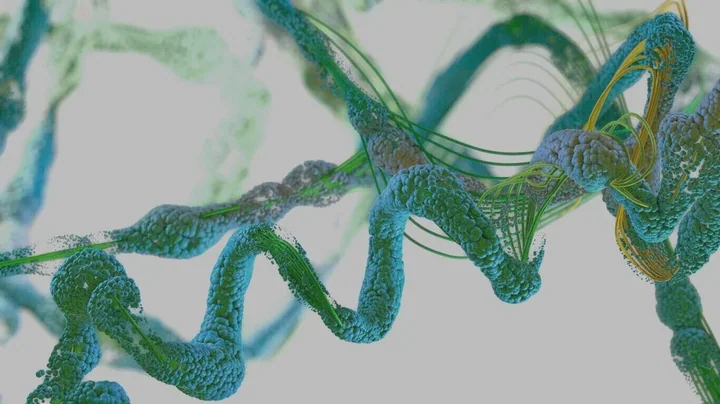
Understanding life from the inside out
Every living cell has thousands of different proteins inside that keep it alive and well.
Proteins carry out the labour within our cells. Their shape determines their function, and those shapes are called folds.
The possible combinations of amino acid sequences are immense, each producing different folds in three-dimensional space. Most yield nothing functional, and some misfolded proteins, such as prions, can be actively harmful, spreading to other tissue and potentially to other organisms that consume them.
Proteins are long sequences of amino acids, which fold into these structures. All the information required for a fold is encoded by the amino acids and their sequence, which is in turn encoded by DNA. In theory, knowing only a DNA sequence should be enough to work out both the resulting protein and its structure.
Resolving a protein structure is painstaking work: a blend of human and machine labour, inferring properties from a snapshot captured in crystallised form.
Scientists have studied protein folding for decades, working to map the three-dimensional shapes of the proteins responsible for a vast number of biological processes. Only a tiny portion of the known proteins have ever been accurately modelled.
Google’s DeepMind claims to have created a machine learning system, AlphaFold 2.0, that can predict a protein’s structure in days, given only the primary structure (the sequence of amino acids in the polypeptide chain). This approximate solution arrived far sooner than most expected: something of a Sputnik moment in structural biology.
If one can predict the structure of a protein given a certain sequence, biology becomes an open book instead of a confetti of letters.
This could lead to drugs that work more efficiently and with fewer side effects, cures for diseases including cancer, more nutritious plants, and plastic-deconstructing enzymes. Perhaps even lifespan extension.
Cultured protein such as meat, and the bioprinting of organs, may advance more quickly. There’s even potential in evolutionary research. We can rewind the tape of evolution by experimenting with amino acids one by one.
There are limitations. The reported precision is not perfect, though it is generally a decent approximation. Results still lean heavily on existing input data and known references; the system appears to predict that certain exotic proteins fold like common ones, and reportedly only around two-thirds of DeepMind’s predictions matched empirical truth.
Knowing the structure of a protein alone doesn’t tell you what ligands will bind it. (Drugs are ligands.) That’s likely to be a significant next challenge, as we already have structures available for most proteins of particular interest.
Despite reports to the contrary, protein folding has not been “solved”. But this is one of the hardest and most important problems in computer science, and AlphaFold appears to be a genuinely significant advance. Right now we know the structures of only a tiny percentage of all known proteins. Soon, we may have an educated guess about all of them.
Editorial note (2026): it came true. By 2022 the AlphaFold database held predicted structures for more than 200 million proteins, nearly every one known to science, and in 2024 Demis Hassabis and John Jumper shared the Nobel Prize in Chemistry with David Baker. AlphaFold 3, released the same year, extended prediction to how proteins bind other molecules.
Correspondence
Or send Nell a private note (only Nell and the editorial team see it).
← All essays