Sep 2020
Webs over the World
Cheap rockets and cubesats are putting eyes and broadband in orbit, and making it harder to hide pollution, slavery, or an undeclared swimming pool.
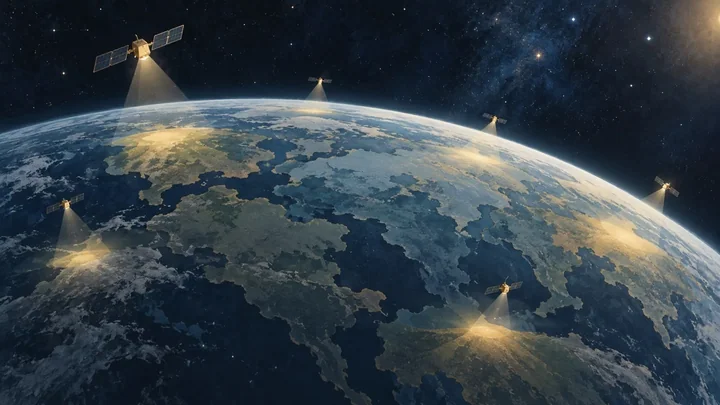
A world brought ever closer
Since Tsiolkovsky’s early experiments over a century ago, humans have yearned for the stars. During the space race the US and the Soviet Union firehosed enormous sums into reaching for the moon (NASA alone took up to 4 per cent of the US federal budget). Space was so expensive, difficult, and dangerous that it seemed reserved for only the most prestigious states.
In the 21st century, this began to change. A new era of private space initiatives has emerged. Rockets have become far cheaper and simpler, and a new generation of reusable rockets has been developed. This is slashing the cost of sending payload to orbit, enabling a democratisation of access to space.
Satellites have similarly become a great deal cheaper. This is partly due to reduced payload costs, and partly due to miniaturisation. 10cm-cube (1U) cubesats are very popular. A lot of components can be crammed into this tiny volume, and the finished cubesat can hitch a ride next to a larger satellite (the nose-cone fairing usually leaves spare room around the main payload). This makes the final frontier massively more accessible to smaller organisations. Now even some high schools have their own satellites.
New machine learning techniques such as super-resolution mean that even very modest imaging hardware can have massively improved fidelity, and can resolve tiny details that once even the most sophisticated government spy satellites had difficulty perceiving.
This enables new ways of understanding our Earth. Many companies are now providing high-resolution imagery of our planet in real-time. Satellite crop monitoring, as well as prediction capabilities based upon weather patterns and climatic conditions, enables high-tech precision agriculture. This increases yields, and requires fewer pesticides and fertilisers that can harm fragile ecosystems.
We can also use similar techniques to monitor pollution in new ways. For example, companies and NGOs now offer pollution tracking services, monitoring the size and duration of smoke plumes, as well as colour across a range of wavelengths to find out what chemicals are being released.
The same view from above catches tax dodgers. Only 324 swimming pools in the wealthy suburbs of Athens had been declared to the Greek tax authorities. Satellite imagery found 16,974.
This kind of technology lets us track and understand environmental impacts in precise ways that were not feasible before. Governments can present an itemised bill for environmental costs shifted onto others. The democratisation of these technologies also enables citizen scientists to hold people accountable even when states cannot or will not.
Satellite technologies have also been used to safeguard against major social problems such as slavery. Slaves are often used in illegal clay manufacturing operations in the Indian subcontinent. By sharing satellite imagery with a crowd of volunteers, 30,000 clay firing sites were quickly pinpointed from space.
Now that volunteers have labelled these sites, their labels can train a machine-learning model to find new ones automatically, any time, any place. Police raids have followed, and enslaved workers have been freed.
New low-altitude, dense satellite networks are enabling worldwide high-speed, low-latency broadband. Now even the most remote parts of the world are able to participate in global networks of commerce, and to stream high-fidelity data to and from anywhere. This makes connecting our planet far more accessible, and sidesteps many of the limitations and systemic fragility of land-and-sea based national infrastructures.
The real power will come once we integrate visuals from the sky with sensor readings from drones or Internet of Things sensors, with data publicly accessible via secure, immutable, yet anonymised blockchains.
This will enable us to fully automate the tracking of environmental and even social externalities in new ways. The pollution that a product cost to produce, along with any social misery, as well as its eventual decommissioning, can all be tracked to ensure that fair dues are paid, and that no-one gets away with ‘fly tipping’ problems for others to deal with, even those far away in time and space.
Satellite technology is here to stay. It will serve as a democratised panopticon, increasing the accountability of bad actors while bringing informational awareness and opportunity to anyone who desires it. Satellite networks are a cocoon that can protect all people and connect all nations, irrespective of borders, empowering rich and poor alike in the decades to come.
Update, October 2020
Commercial yet best-efforts beta tests have now begun on Starlink. $100 a month for all you can eat satellite internet is a huge deal for remote communities, especially as DSL heavily attenuates just a few km from an endpoint. 40ms latency is nothing compared with satellites in geosynchronous orbit (540ms round trip).
It remains to be seen what effect such technologies will have on the internet as a whole. It could be a bulwark against the trend of further fragmentation into national internets by making such efforts moot. Alternatively (perhaps more likely), it may prove an uncensorable disruption that drives authoritarian regimes crazy trying to stamp it out, especially if paired with a mesh network that can piggyback signals a long distance out towards a hidden illicit transceiver.
Update, December 2020
Hyundai’s buy-in to Boston Dynamics for $880 million will probably pay off for them. BD is the world leader in robots that combine agility, strength, and independent movement, as demonstrated in their recent choreographed holiday dance video. The purchase will let Hyundai embed these powerful technologies across their broader portfolio and build more capable versions of their existing products and services: autonomous lawnmowers, cleaning robots, and self-driving dump trucks.
We are starting to see the public deployment of delivery robots such as Starship and Nuro. It will take a few years yet before BD’s robots are safe to operate in public areas, but the gap can be filled by using them as avatars for human pilots. With low-latency satellite coverage, we can access a global labour pool of virtual delivery people who telecommute into a robotic system to perform tasks. The recorded performance then provides a perfect dataset for training AI systems to operate increasingly autonomously.
As a Judge for the ANA Avatar XPRIZE, I know that these technologies are maturing incredibly quickly. The company that nails practical avatar robotics will be the next addition to the Big Tech pantheon.
Correspondence
To send Nell a private note, select any passage above and choose ✎ Note, or write about the essay as a whole. Only Nell and the editorial team see notes.
← All essays