Jan 2017
The Technological Wavefront
Civilisations require enough momentum to constantly escape resource constraints.

Technological development isn’t only in one direction
Half a century ago, nations like India faced a Malthusian Catastrophe of epic proportions. It was only through the diligence of Norman Borlaug’s team that the Green Revolution raised our societal carrying capacity.
A general rule seems to hold: as population grows, resources tighten. Society specialises further, which raises complexity, which demands still more diverse resources.
These effects intertwine over long periods of expansion, and continue as long as conditions stay favourable.
There is a technological wavefront (organisational, complexity-driven) whereby expanding resource needs are met before they become critical. So long as they are met just in time, the society will expand in complexity.
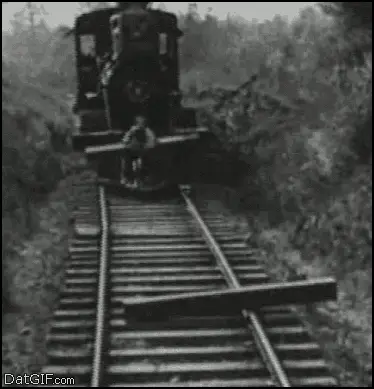
However, a society that faces an inescapable bottleneck will not successfully maintain the wavefront; it will collapse. This will precipitate a stepping-down in societal complexity to a level which is once again sustainable.
In our time, such a bottleneck could be a global financial collapse (derivative markets), or a series of environmental catastrophes. Depending on how many levels of simplification occur, a great deal of knowledge might be lost.
We have vast amounts of data, but it is contingent on servers in a few key clouds. Books are increasingly distributed in digital formats that would be difficult to resuscitate from an e-reader whose battery has worn past its zero point.
No one person knows exactly how a modern vehicle or chip is manufactured. Vast implicit knowledge lives in the heads and procedural memory of a slice of a single generation. Even making sense of code you wrote yourself a few years ago can be a puzzle. Repairing systems whose source has been lost would be futile.
The wavefront in miniature: a robot arm laying track just ahead of a moving train, which keeps running only as long as the rails keep coming.
Train vs. Robot: a robot arm laying track just ahead of a moving toy train (on YouTube)
Our momentum as a species keeps the light of enlightenment burning. Lose that momentum, and we cannot regroup a few generations hence and try again. The intermediate resources required to reach our present technology level are gone. The cheap, easily accessible energy is depleted, and without it we cannot rebuild the knowledge and industrial capacity to move to solar panels and thorium fuel-cycle molten-salt reactors, the only sources available worldwide that give back far more energy than they cost to build, enough to fund a climb back to our present complexity.
We’d be stuck. Marooned Neo-Edwardians with dim memories of a golden age where we chatted in our kitchens with thinking machines that knew any fact, yet were quizzed on trivialities like the day’s weather.
The idea of asking, ‘is that all there is to a sapient species?’ strikes me as almost as tragic as complete destruction, and vastly more likely.
If walking on the moon is not to be our one-hit-wonder as a species, our technological wavefront cannot fail. The greatest existential risk to the meaningfulness and excellence of the future of humanity may be something surprisingly benign, not to be experienced as a bang, but rather as a long drawn-out whimper.
Therefore, along with X-Risk, there is W-Risk: Wavefront Risk (or Whimper Risk).
W-Risk is harder to think about. X-Risk is ‘okay’ at least in the narrow sense that whatever suffering it entails is likely to be over abruptly. W-Risk may be a long drawn-out trans-generational dwindling lament.
How then might we best safeguard against W-Risk?
Pollution, nonrenewable resources, and systemic risk will eventually drag us back into the abyss unless we can surf inside a tube wave crashing all about us, yet somehow keeping us dry.
These are hard questions, ones I am not sure are being fully addressed, or even could be. But since W-Risk is much more likely than X-Risk, it deserves more priority than it presently receives.
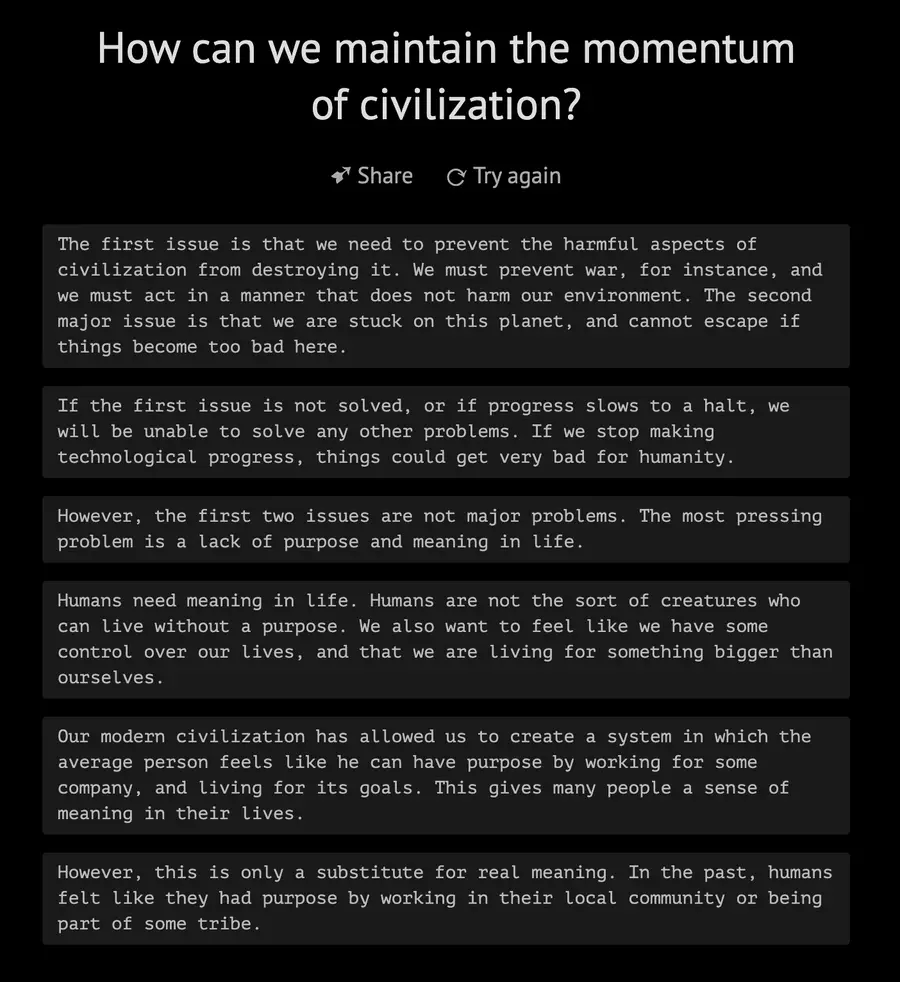
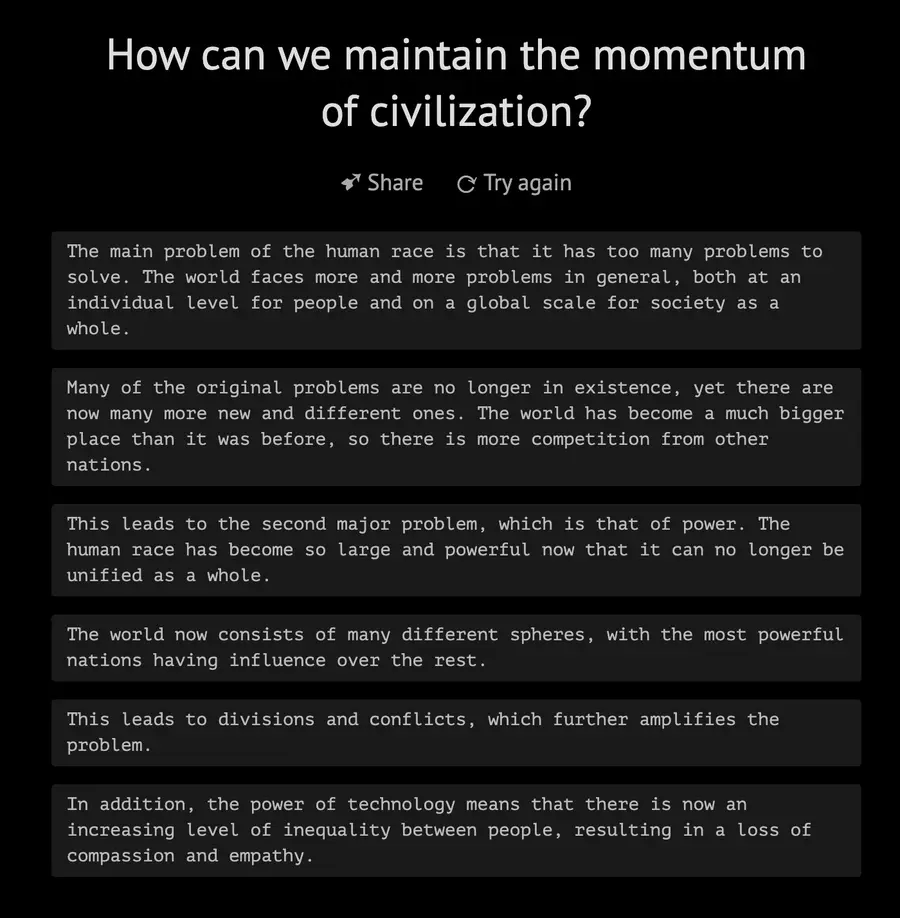
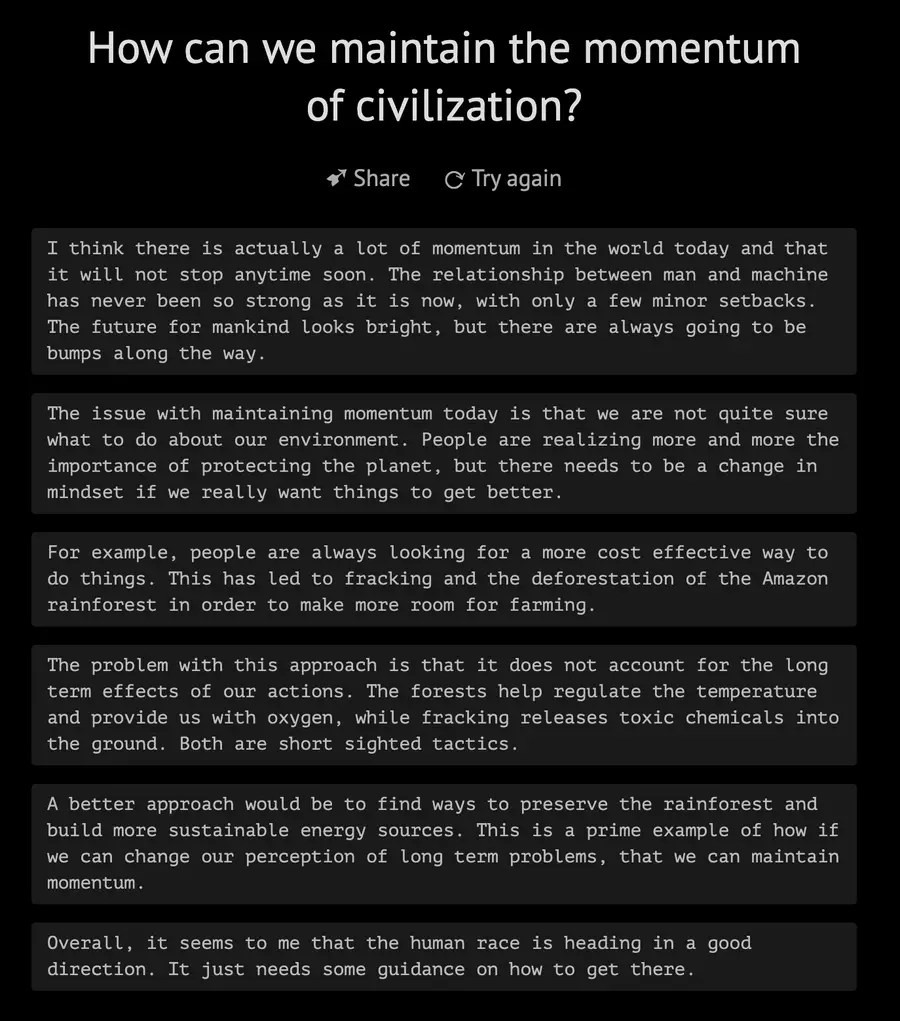
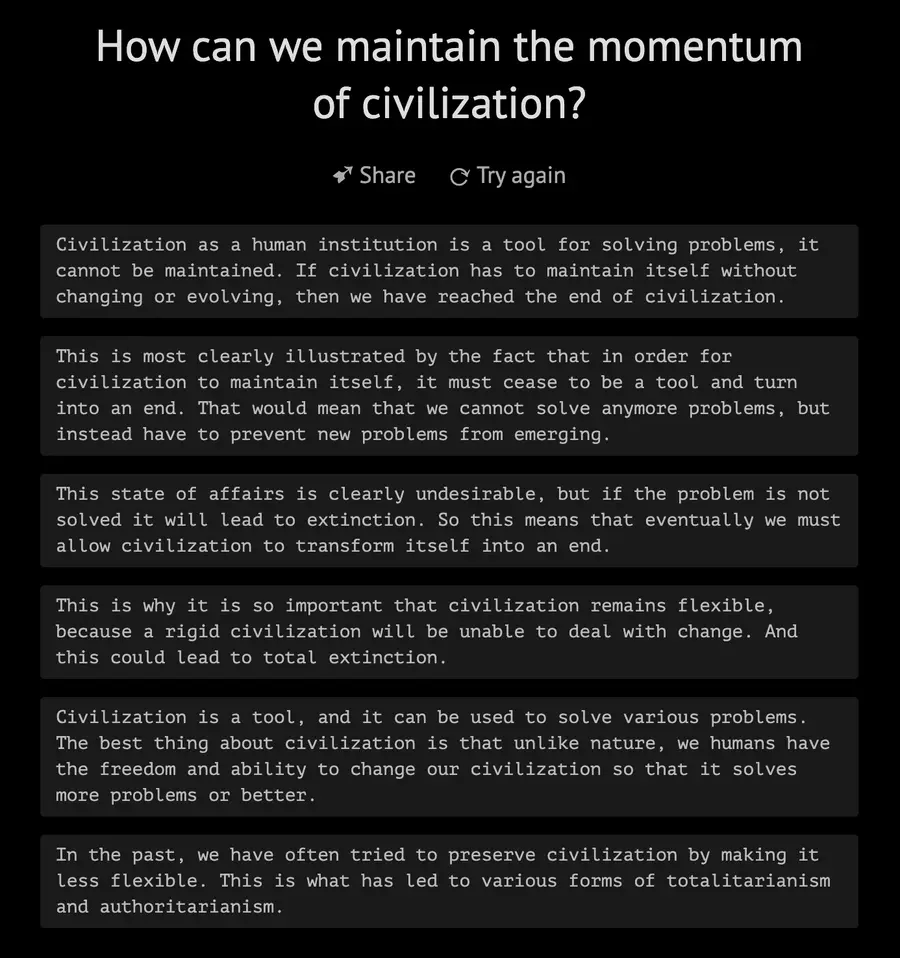
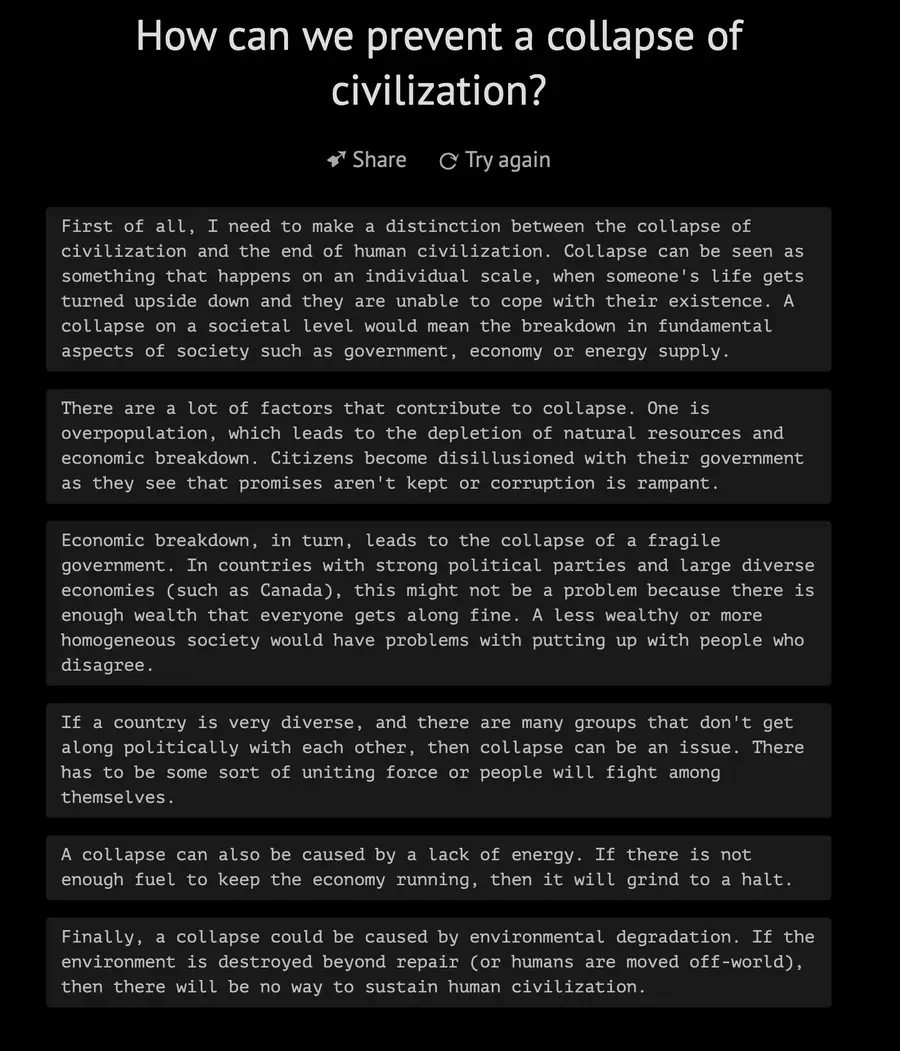
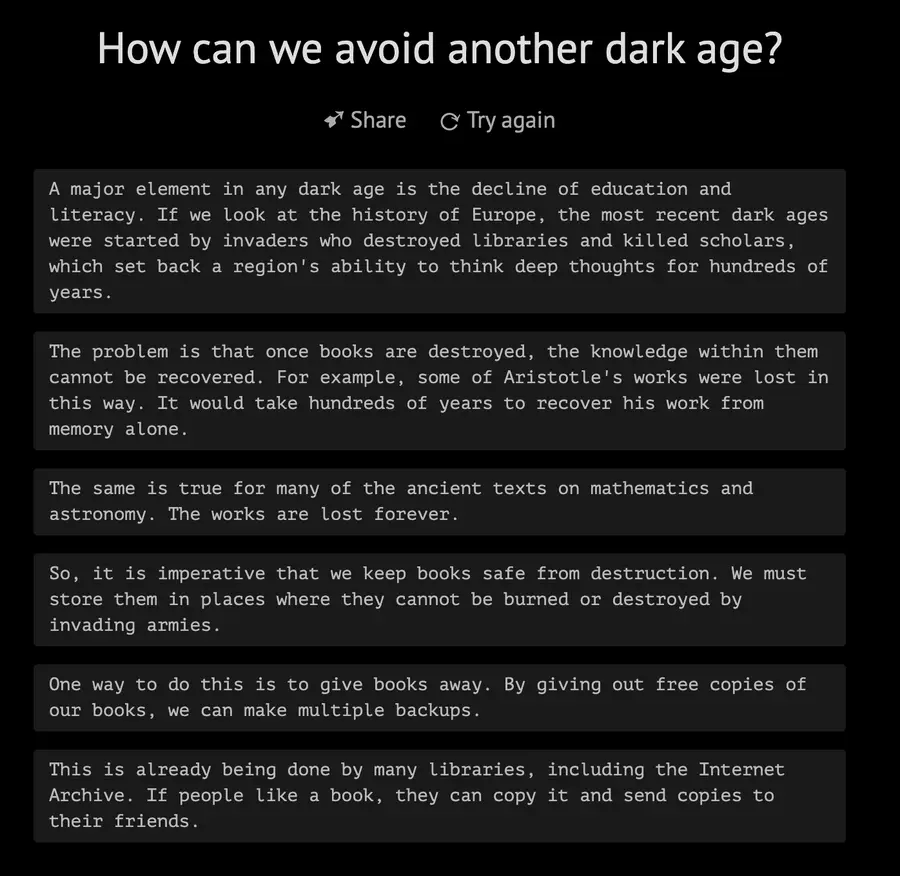
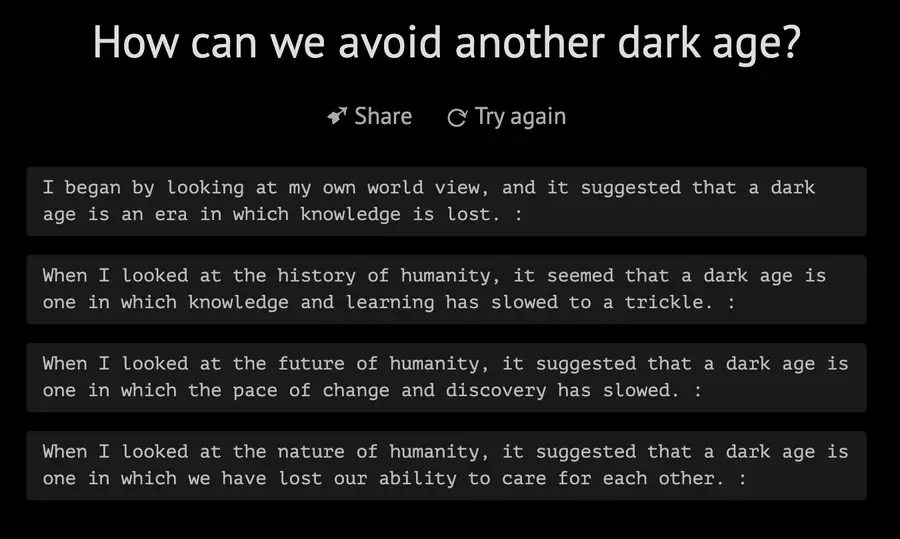
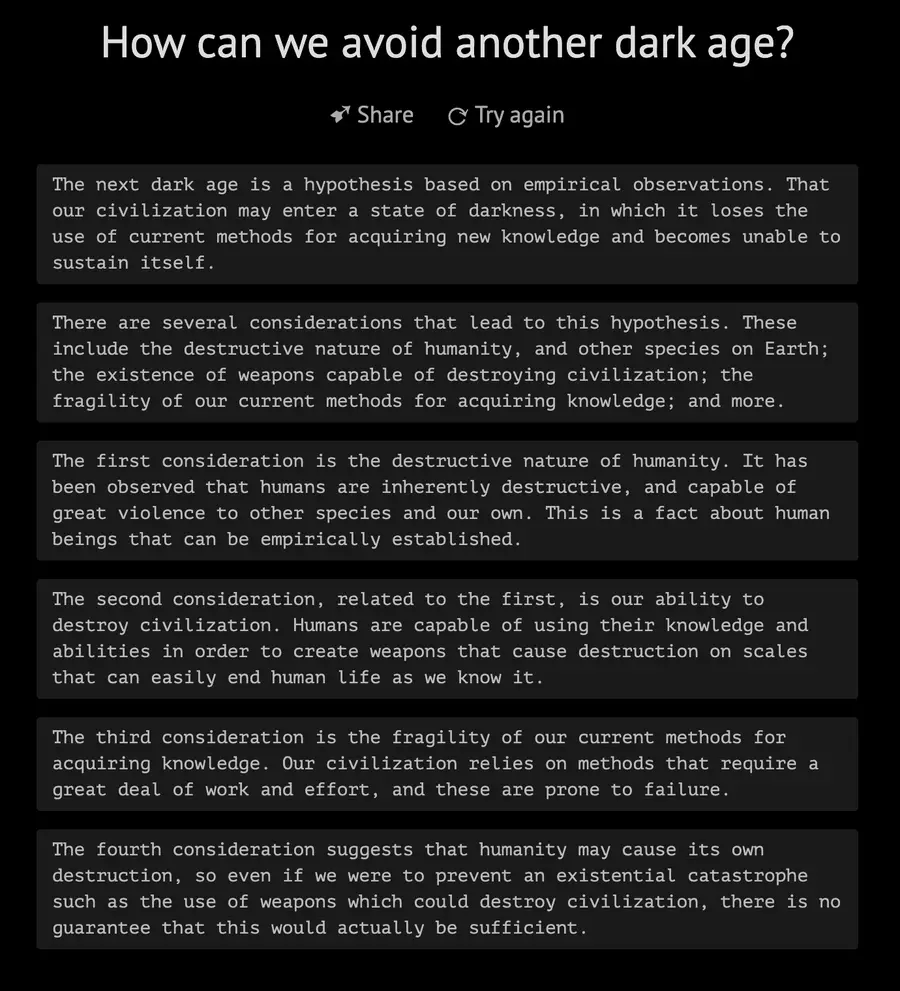
I posed some of these concerns to GPT-3, ironically a harbinger of X-Risk, but one that might keep the W-Risk wolf from the door.
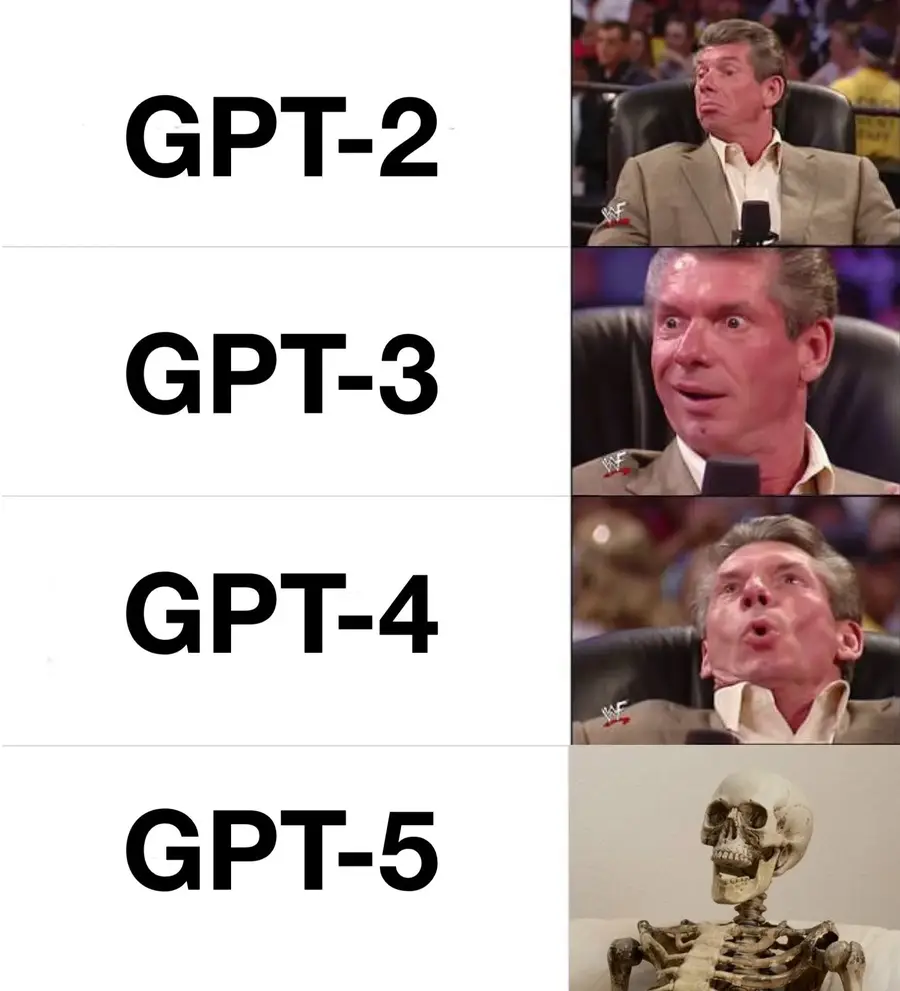
Below are hen’s responses to my queries:
Correspondence
To send Nell a private note, select any passage above and choose ✎ Note, or write about the essay as a whole. Only Nell and the editorial team see notes.
← All essays