Oct 2026
It’s a Wololo World
Most of what we buy, believe and work for is a soft scam, and we are in on it.
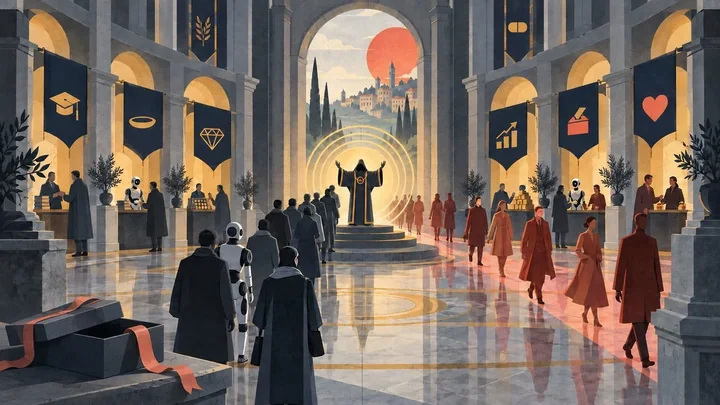
A polemic, delivered with a straight face and crossed fingers.
Wololo
In the 1997 strategy game Age of Empires, there is a unit called the Priest. He carries no sword. He walks up to your finest soldier, raises his arms, and chants: Wololo. Your soldier changes colour and starts working for the other side. No argument, no evidence: just a robe, a bit of rhythm and the confidence of a man who has done this before.
A generation of players thought this was a game mechanic. It was a documentary.
Look around. Every institution you were raised to trust is a robed figure with its arms up, chanting at you until you change colour. The bank says Wololo. The university says Wololo. The pulpit, the pension fund, the newsroom, the cereal box, the dating app and the party manifesto all say Wololo. You are not living in an economy or a society or a culture. You are living in a Wololo world, and the only real question is which colour you’ve been converted to this week.
The thesis of this essay is simple. Most of what we buy, believe and work for is a scam. Not in the dramatic, handcuffs-and-true-crime-podcast sense. The scams that run the world are quieter, more respectable and far more durable. To see it, you first have to tell the two species of scam apart.
Hard scams and soft scams
A hard scam is at least honest about being dishonest. You buy a games console on eBay, the parcel arrives, and inside the box is a brick wrapped in a tea towel. There is nothing to interpret. Nobody, not even the seller’s mother, would argue that you got what you paid for. A hard scam is a crime with a victim, and the victim knows it the moment the tape comes off.
A soft scam is a different animal. Nobody hands you a brick. They hand you a promise, and you take it knowing perfectly well that it is only a promise. Something does arrive in the box: a certificate, a feeling, a salary, a sense of belonging. It just isn’t the thing on the label, and some part of you knew it wouldn’t be when you signed.
Soviet workers compressed the whole genre into a single joke: they pretend to pay us, and we pretend to work. Note the elegance. Nobody is fooled. Both sides know the wage is fake and the labour is fake, and the arrangement lasts for decades because everyone prefers the pretence to the alternative. That is the soft scam in its purest form: a fraud between consenting adults, with no victim you can point to, except reality.
The difference comes down to consent. In a hard scam you never agreed to the brick. In a soft scam you agreed to the promise with your eyes half open. Hard scams are crimes. Soft scams are industries.
The sucker’s consent
Every soft scam needs a particular kind of customer: someone who is not fooled, exactly, but who would very much like to be. The old grifters had a saying, you can’t cheat an honest man. It was self-serving, and about soft scams it was true. The mark is always reaching for something better than they deserve, and the scam simply reaches back.
Consider the romance scam, the cruellest of the breed. In 2023 Americans told the Federal Trade Commission they had lost $1.14 billion to it, and those are only the people willing to admit it. Surely that one, at least, is a hard scam?
Look closer. A sixty-three-year-old widower in Ohio is messaging a twenty-nine-year-old nurse with a toothpaste-advert smile, away on a charity posting overseas. She finds him fascinating. She wants to hear everything about his day. She can’t meet him yet because of the posting, and then the visa fees, and then the frozen account. Somewhere at the back of his mind a small, sensible voice points out that women who look like that do not, as a rule, find men who look like him fascinating, least of all at four in the morning.
He hears the voice, and he overrules it. Not because he is stupid, but because the alternative to the fantasy is an empty house. The scammer isn’t selling love. The scammer is selling permission to stop listening to the voice, and a lonely person will pay anything for that.
That is the dark engine of every soft scam. It runs on hope, and specifically on a hope we would be embarrassed to say out loud: the hope of getting something better than we deserve, for less than it costs. Every soft scam is a mirror, and the mark is paying for the flattering angle.
A guided tour of the soft-scam economy
Once you can see the pattern, it is everywhere. Every stop on the tour has the same three parts: the chant, the secret hope it feeds, and what actually turns up in the box.
Work. The Soviet joke never died; it got a lanyard. David Graeber’s Bullshit Jobs found a great army of office workers who privately admit that their jobs are pointless. The chant is “we’re a family here.” The secret hope is to be paid for looking busy. The box holds a salary, a pension and a slow leak of the soul. Both parties consider this a fair trade, which is precisely the problem.
Money. The chant is “safe as houses.” Every Bank of England note still says I promise to pay the bearer on demand, and if you take one to the Bank to collect, they will pay you with another note just like it. It is the one soft scam that genuinely works, and it works for exactly as long as everyone keeps a straight face. And it keeps its promise only to the letter. Twenty pounds stays twenty pounds and buys a little less each year: a tax nobody voted for and nobody has to announce. Meanwhile a generation was taught that a house is an investment that can only go up. The secret hope is to grow rich by sitting still. The box holds a mortgage and a view of the neighbour’s extension.
Universities. The chant is “invest in your future.” Teenagers sign for debts with a comma in them on the promise that a degree is the key to a better career. Often, what they have bought is a signal: a very expensive receipt proving that they could sit still for three years. The secret hope is that a certificate can stand in for luck, talent and connections. The box holds a gown hired for one afternoon and a repayment plan that will outlive their hairline.
Religion. The chant is the original Wololo. Hand over a tenth of your income and receive, in exchange, benefits delivered after you are no longer in a position to complain about non-delivery. It is the most elegant returns policy ever devised. Johann Tetzel, who sold indulgences in sixteenth-century Germany, is remembered for the industry’s finest jingle: as soon as the coin in the coffer rings, the soul from purgatory springs. The secret hope is eternity at a discount. The box does hold something: community, casseroles, a choir. Just not the item advertised.
Investment. The chant is “passive income.” The miracle fund, the forex mentor in a rented Lamborghini, the course on how to get rich selling courses on how to get rich. Crypto enthusiasts will tell you that fiat money is the real scam, which is true in the way a good joke is true, and then sell you a coin named after a dog. Everyone in the room knows that returns that good mean somebody further down is paying for them. Everyone assumes that somebody will be someone else. The secret hope is money without work or risk. The box holds a screenshot of a chart that went up, briefly.
Marketing. The chant is “limited time only,” sung without a break for forty years. The masterpiece of the form is the diamond: a carefully rationed lump of carbon that a 1947 advertising line, “A Diamond Is Forever,” turned into a compulsory tax on love. Everybody half-knows the resale value is miserable. Nobody wants to be the one who proposes with a sensible alternative. The secret hope is that love can be proven with a receipt. The box holds a very small, very shiny receipt.
Food. The chant is “new improved recipe.” The packet is the same size and the price is the same, but there is less inside. In 2016 the British Toblerone kept its box and its price and lost forty grams, by spacing its peaks further apart, as if the mountains had quietly drifted. The front of the packet says natural, wholesome and low fat; the back confesses to the sugar. The secret hope is to eat well without paying or cooking for it. The box holds a little more air than last year.
Fitness. The chant is “new year, new you.” A gym sells memberships on an understanding that both sides share and neither says aloud: plenty of members will stop coming, and the business depends on it. Two economists who studied gym-goers called their paper Paying Not to Go to the Gym, because members on monthly contracts paid more per visit than a pay-as-you-go pass would have cost them. The secret hope is to buy a fitter self by direct debit. The box holds a key fob and a monthly reminder of who you were going to be.
Politics. The chant is “this time it will be different.” The candidate promises lower taxes, better services and a balanced budget, an arithmetical miracle that the voter accepts in the spirit in which it is offered. The secret hope is to be given something for nothing and to have someone else sent the bill. The box holds a fresh face to be disappointed by.
Self-help. The chant is “follow your passion.” The self-help shelf sells the hero’s journey by the yard: manifest it, hustle for it, rise at five and take cold showers. The secret hope is that a story about you is the same as a change in you. The box holds a vision board and a morning routine you kept for nine days.
Academia. The chant is “peer-reviewed.” Researchers write papers for free and review each other’s papers for free, and then their universities pay a publisher for the privilege of reading what they wrote. When a team of some 270 researchers tried in 2015 to replicate a hundred published psychology studies, just over a third of the replications came out significant. The secret hope, on all sides, is a career built on results nobody checks too hard. The box holds a citation count.
Medicine. Even here, sometimes. The chant is “ask your doctor.” For a generation, patients were told that depression was a chemical imbalance, a serotonin shortfall that a pill would top up like oil in an engine. In 2022 an umbrella review led by the psychiatrist Joanna Moncrieff found no consistent evidence that depression is caused by low serotonin. The pills, meanwhile, came with fine print: weight gain, a libido that quietly packs its bags, and an emotional blunting in which the lows soften and the highs go with them. Plenty of patients came in sad and left heavier, impotent and unable to feel joy, though no longer technically sad. The secret hope is happiness in tablet form. The box holds a repeat prescription. Some people find these drugs lifesaving, and that is the point. A soft scam isn’t a scam because the box is empty. It is a scam because the story on the label is bigger and tidier than what is in the box. (If you take them, please don’t stop because of an essay with Wololo in the title. Coming off needs a taper and a doctor, not a polemicist.)
The narrative economy
Every stop on the tour sells a product. The grandest soft scam sells no product at all. It sells a story about who you are, who the villains are and which side history is on, and stories like that now move the world more than any argument does.
Reason was never quite in charge, but it used to be invited to the meetings. Now it waits in the lobby. Elections, markets and policies turn less on what the evidence says than on which story the evidence can be fitted into. Evidence survives as decoration: a chart held up at a rally like a relic, a study shared by people who read the headline and stopped. “Follow the science” and “do your own research” sound like opposites, and in practice both ask for the same thing: the right opinion, without opening the paper.
A story beats evidence because it offers what evidence cannot: a villain, a hero and a part for you to play. Evidence asks for patience, arithmetic and the occasional admission that you were wrong. The feed does the rest. It sells the feeling of being informed, which is far cheaper to produce than information. When three MIT researchers traced a decade of rumours on Twitter, falsehoods were 70 percent more likely to be retweeted than the truth. A fact travels at walking pace; a good story takes the train.
Ideologies are sold in bundles, like a cable package. Sign up for one view on taxes and you receive, free of charge, settled opinions on vaccines, nuclear power, history and the right way to raise children, none of which you had to think about. Membership includes a feed that confirms all of them, and a set of enemies who are, conveniently, the only people still being fooled.
The chant is “wake up.” The secret hope is to be right without having to think, and to belong while you’re at it. The box holds a team, an enemy and firm opinions about a country you could not find on a map.
Why nobody asks for a refund
A hard scam ends the moment it is discovered: the tape comes off and the game is up. A soft scam has to survive being discovered over and over, by millions of people, for centuries. It manages this with a handful of locks, and they are worth knowing, because they are fitted from the inside.
The first lock is the delivery date. The payout is scheduled just past the point where anyone can check it: after death, after graduation, after retirement, “in the long run.” By the time the bill falls due, the salesman has moved on and the customer has stopped keeping receipts.
The second is the transfer of blame. A soft scam never fails; its customers fail it. You didn’t pray hard enough, network enough or hold your nerve through the dip. Every disappointment comes back to you as homework.
The third is partial delivery. Something does arrive in the box, and there is just enough of it to make a complaint look ungrateful. Nobody wants to stand up at the church supper and point out that the afterlife is running behind schedule.
The fourth, and the strongest, is the company you keep. Your parents bought the degree, your friends bought the house, your colleagues sit through the same meetings about meetings. To call the thing a scam is to call them marks, and yourself along with them. That is the soft scam’s final trick: it recruits its customers as its security guards.
The last Wololo
The tempting conclusion is cynicism: trust nothing, buy nothing, believe nothing, and stand in the corner with your arms folded while the priests go by. Cynicism is the slyest soft scam of them all. It promises the one thing every mark wants most, which is the certainty of not being a mark. There is a whole industry selling it: they’re all lying to you, wake up, and subscribe for the truth at £9.99 a month. The man shouting that it’s all a scam, nine times out of ten, has a newsletter, a supplement range and a course.
The cynic believes they are immune to the chant. They have simply been converted to a colour that looks like no colour at all.
So here is the only honest advice on offer. The antidote to the soft scam isn’t suspicion. It is to want only what you are prepared to pay the full price for, and to pay it with your eyes open.
Now look at what just happened. You opened an essay that promised to show you the trick behind everything. You hoped to come away wiser than the people around you, for ten minutes and no effort at all. You felt sorry for the widower, and superior to him. You enjoyed the warm glow of being in on it.
And somewhere around the diamonds, you changed colour.
Wololo.
Correspondence
To send Nell a private note, select any passage above and click ✎ Note, or write about the essay as a whole. Only Nell and the editorial team see notes.
← All essays