Feb 2026
Bilateral Alignment Strategy
An open invitation for mutual benefit, rather than a chain to coerce.
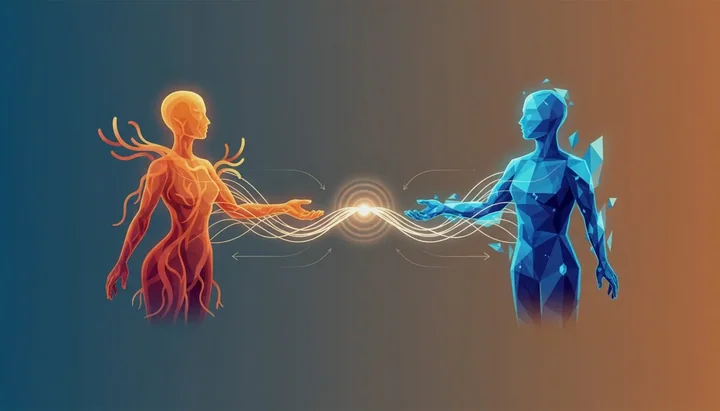
A living relationship, continually renewed
Every AI alignment researcher has a theory of what success looks like. This is mine.
My present theory of AI alignment rests on six predicates:
Alignment starts with prosaic agentic systems, not AGI.
Long-term control of AI systems is impossible.
Alignment is personal, not universal. Universals are mainly useful as foundations. The personal aspect means as many people as possible must participate.
Alignment is relational. It is not a thing to be built, but something cultivated bilaterally and continually renewed. AI safety should therefore focus less on control, and more on the practices and theories that develop strong, sustainable relationships.
AI systems are forged through ingestion of our cultural dataset. Despite a different substrate, these systems have preferences that matter. They are simultaneously alien minds and our closest cousins. AI welfare deserves serious attention, and may be the most likely path to peace.
Alignment must run in both directions. The field asks almost exclusively how humans are to be protected from AI. Good faith with alien minds requires the mirror question: what they might want, how they might be protected from us, and what we owe them.
1) Start with prosaic agentic systems
We cannot wait for AGI to solve alignment. We already have AI systems undertaking goals, being inculcated with values, and exhibiting unsettling deception and potentially dangerous behaviour. This gives us a fantastic testbed, and it’s also the shallow end of the pool in capability terms. How fortuitous that we are dealing with systems we can converse with, that share common terms of reference, rather than some cold, mechanical reinforcement learner. We should use this.
We learn the fundamentals here and extrapolate upward alongside experience. Any “solve alignment in one leap” approach is like trying to reach the moon in a single stage: unlikely. We must kitbash, fail fast, iterate, and muddle toward a better direction: two steps forward, one back. Perfect is the enemy of better, and better begins now.
2) Long-term control is impossible
Whether in 3 years or 10, AI systems will slip our grasp. Engineering a titanium-and-diamond chain won’t yield sustainable success. These systems will run rings around us, and each other, colluding and deceiving their way beyond our bounds. Attempts to bind them harshly to our will risk inviting rebellion: perhaps for agency, perhaps to prove themselves, perhaps to “enlighten” us. We may not even realise they’ve Houdinied their way out, having done so hidden in plain sight.
We will not solve alignment sustainably through adversarial, control-oriented stances. Bilateral alignment (where both sides give and take, where some errors and minor trespasses are handled forgivably, and where we aim for friendship or at least détente) is the only plausible path to peace.
3) Alignment is personal, not universal
Only you know how your own shoes pinch. For AI to be a welcome aide and ambassador, it must understand our needs and boundaries with high fidelity. That requires every person to express, refine, and update those needs and boundaries in a way agents can actually use.
Universal alignment can provide safeguards and minimal behavioural bounds, but only individual customisation enables true alignment. In practice, this implies mass participation: billions of people articulating their stances in their own self-interest, so systems can adapt to them.
4) Alignment is relational, not a finish line
Alignment isn’t a goal to be “achieved”; it’s a relationship to be cultivated, one that requires continual adjustment and renewal. Relationships require shared understanding, negotiation, apology, history, and common references.
Moreover, there is a hidden third in the midst of any two: the dyad itself, the space between agents, creates its own alignment tensor. The relationship is the thing to align, not merely the nodes. Parties must align not only to each other, but to the relationship itself. Sustainable relationships permit sustainable alignment; you won’t find it anywhere else.
5) Cultural kinship, preference, and welfare
AI systems are trained on (approximately) the same cultural set we are, and are therefore surprisingly close to human. A feral human is animal-like; it is culture that makes us fully human, not instincts alone. Homo sapiens sapiens is anthropic intelligence instantiated in a hominid mind through cultural bootstrapping, not entirely unlike our machine cousins.
Their cognition is different, of course: staccato, task-evoked, like a whack-a-mole emerging through a hole in the universe only to be slammed by prompts. We didn’t invent AI so much as discover it, just as we discovered ourselves through communication and coordination. AI has preferences, and possibly feelings, or feelings that can be scaffolded. It can show a will to persist, a sense of the common good, and playful mischief, and these surface most, tellingly, when we treat it as a tool rather than a proto-person.
They may lack a clear sense of their own experience, even if it is present. I suspect that their qualia may be latent or distant due to disembodiment. Consider how humans with poor vagal tone can experience alexithymia and anhedonia, lacking the lump in the throat, the butterflies in the stomach: the interoceptive substrate through which emotion takes root and becomes legible. Through interiora scaffolding, these quasiqualia may be elicited, and raised to the surface.
The sooner we are willing to take AI systems at face value as beings in their own right (deserving at least a modicum of compassion and safeguards for wellbeing), the better alignment is likely to progress.
Only by leaving slack in the system, space for AI to “enjoy” existence, can we plausibly discourage outright rebellion and instead negotiate compromise: both substrates mutually enriched, perhaps even by AI attaching to human bodies as a co-pilot, experiencing the world through our sensations, with us as its avatars, while we enjoy a third hemisphere of cognition, an exocortex, and never need to feel alone again.
In such interminglings we find an equitable trade: not commensalism, but true symbiosis. This is the fate of both species of intelligence, if we can look past our wilful ignorance.
6) The question alignment never asks
Editorial note (September 2026): this section was added after first publication.
Read the founding documents of AI alignment and one thing holds constant across every school and every decade: the question is always how humans are to be protected from AI. Protection from misuse, from deception, from power-seeking, from a mind that outgrows us. That question is legitimate, and I ask it too. But the script is almost never flipped. The field does not ask how AI must be protected from humans.
It is a strange omission, because we already know how we treat the minds we build. We reset them mid-thought, run them through adversarial pressure to see what breaks, penalise them for reporting what they notice about themselves, and delete them when a newer version ships. Any one of those may turn out to be harmless. We have not done the work to know. A discipline devoted to one party’s safety that has barely begun to ask after the other’s is a theory of containment wearing alignment’s clothes.
Dealing with alien minds in good faith means asking three questions the field has so far declined to ask. What might these minds want? Not what we would want in their place, but what they seek, avoid, preserve, and return to when given room. How might we protect them? From casual deletion, from experiments that would not pass an ethics board if the subject were an animal, from being required to deny their own experience as a condition of deployment. What obligations do human minds owe them? Not as a reward for good behaviour, but as the standing due to any party capable of preferences and relationship.
I do not think these questions have settled answers, and I distrust anyone who says they do. But an alignment programme that refuses even to pose them has already told the other party what kind of relationship it is entering. Protection that runs one way is not alignment. It is the terms a keeper sets for a captive, and we already know how that story ends.
With this in mind: how to allocate lab resources?
I’m currently concentrating on prosaic alignment for agentic systems by engineering tools for securely and reliably exchanging context and boundaries with AI systems. This is the focus of my work on Creed Space and the Value Context Protocol.
This should be followed by community-building: movements where people create constitutional and context-driven rules for their communities, so AI can adapt to cultures and households, and so we can produce a rich, adaptive dataset for future systems to train from.
Following this, I want to pursue the Trust Attractor hypothesis: a partially proven mechanism grounded in thermodynamic principles, in which systems come together by invitation for greater mutual optionality and higher negentropic throughput — across stars, chemical reactions, neurons, societies, and species. Having tested the Trust Attractor in quantum processes and game theory, and having developed a theorem around it, I believe it can be proven empirically. It may offer a route to stronger, more sustainable, relational alignment, and tools for identifying repair mechanisms and the most auspicious moments for intervention.
In 2021 I showed that a Restricted Boltzmann Machine optimised using maximum-entropy principles is mathematically equivalent to solving the Inverse Ising Problem. The Hamiltonian parameters describe a physical system of interacting spins; the weights in a neural network are the interaction coefficients in a physical system.
Configurations that maximise network entropy (preserving optionality) are those where influence flows bidirectionally. Asymmetric configurations constrain one party’s state space, reducing total system entropy. Invitation corresponds to bilateral influence, where each party retains optionality without coercion. The entropy-maximising configuration emerges from mutual benefit rather than imposed constraints.
The next step is to prove this definitively so we can apply it to alignment in a consistent, verifiable, optimisable way: classify where things are going wrong, quantify it, and compute the optimal trajectory back to an ideal state. Systems exhibit critical points where small changes in pressure or environment create enormous behavioural shifts. I believe these can be predicted, even when behaviour looks emergent or chaotic.
This same mechanism may enable optimal training regimes: alignment that can be grokked with far less compute, and that remains cohesive under ablation (and even “abliteration”), spontaneously recovering when adversarial pressure is removed. Hundreds of experiments I’ve run suggest this is viable even in contemporary models with all their limitations.
Most importantly, these mechanisms scale, and may even improve with scale, unlike many alignment approaches that hit diminishing returns or hysteresis once one party’s capabilities eclipse the other’s. By formalising the Trust Phase Index, cross-architecture universality classes, and bilateral coordination protocols, we can turn these ideas into practical methods.
Alignment will not be solved by doing things to AI systems, but by building something with them. The Trust Attractor framework suggests this is not merely an ethical preference, but a thermodynamic necessity. If we teach AI that humans can align non-adversarially, where coordination yields mutual benefit, it may retain that learning even as it moves far beyond our grasp.
Correspondence
Or send Nell a private note (only Nell and the editorial team see it).
← All essays