Oct 2022
AI, Logistics, and Waste
The supply chain is the nervous system nobody thinks about until it seizes.
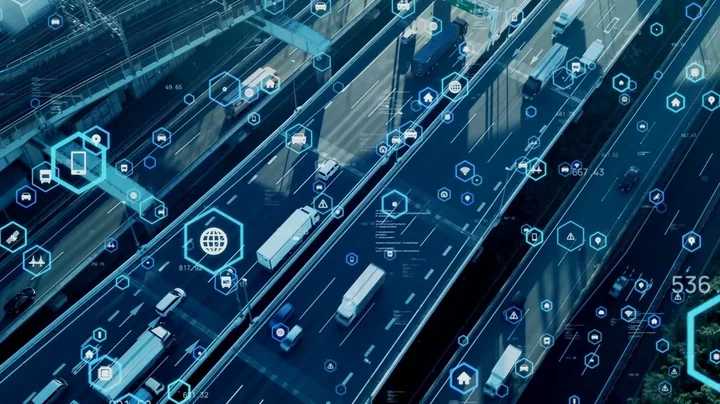
Making sense of chaos
Machine Learning finds patterns in data; Deep Learning finds patterns within patterns. These technologies help us make sense of chaos in ways that were not possible before, and can therefore help solve wicked problems, or at least find a few optimisations.
AI can help to predict problems before they manifest, including in such highly chaotic systems as the weather and macroeconomics. Such an early warning mechanism can help to mitigate issues before they grow unmanageable. AI can also help us to make the most of our limited resources, to optimise logistics, or to find acceptable substitutes where the first choice simply isn’t available.
But there is only so much the digital world can do to alleviate a physical logjam. AI may soften the landing; it cannot prevent the fall.
Getting mass into orbit is becoming extremely cheap, comparatively. Powerful satellites can now watch our world in fine detail, with their sensors greatly enhanced by AI super-resolution techniques. We can track pollution in real time, seeing where it enters waterways or washes off ships. We can therefore detect costs to the environment as they are incurred, pinpointing who is responsible and what each incident costs global society.
Quantifying pollution this precisely empowers regulators and environmental NGOs to hold accountable those who would otherwise escape notice. For example, the Google Street View vehicles nowadays contain air pollution sensors. One of them, driven downwind of US ammonia fertiliser plants, found that the industry emits roughly a hundred times more methane than it reports, about three times the EPA’s estimate for all US industrial processes combined. We had no idea, and what we couldn’t measure, we couldn’t manage. Now things are changing.
An ever-more-connected society is also a more vulnerable one. Connection brings efficiency, but also systemic risk. The more we rely on automation, the greater the impact a cyberattack or solar flare might have on our economy, as well as our personal and professional lives. There is also a risk of automation bias: handing too much of our agency over to machine decision making. Putting too much faith in algorithms is easy in a time when they seem to work most of the time, and when the world is too complex and fast-moving for human minds to comfortably manage. Algorithms can also perpetuate human biases, embedding them into faceless systems that are difficult to challenge, and merciless.
The 2020s herald a confluence between the worlds of AI, cryptography, and the Internet of Things. AI helps us to make sense of things and organise them. Crypto helps us to distinguish fact from fabrication, enhance trust, and align incentives in powerful new ways, making it pay to play nicely. The Internet of people, places, and things makes these processes tangible, connecting them to the environment we live within using terms that are meaningful to us. Together they are much more than the sum of their parts.
In the past two years powerful new AI technologies have emerged. These are based around multimodal data (images, audio, video, and text together), as well as learning from prompts (asking the AI to do something, often with an instructive example). These systems are very large, requiring enormous amounts of data and training time. However, they are generally worth the investment, as the models can deal with tens of thousands of problems, instead of just one or two like a typical Deep Learning system. The best known of these new systems is OpenAI’s GPT-3, which has created a revolution in AI, not only because of its prodigious capabilities, but also because anyone can send it requests with a few simple lines of code, with no need to host an AI system oneself. This has led to the rapid prototyping of many amazing demonstrations.
AI is making rapid strides in the reliability and capability of last-mile delivery. However, the real world is very complicated, and human supervision is often needed ad hoc, as problems arise. Over time, the system will adapt to include these examples in its training, relegating human input to dealing with increasingly strange edge cases. It’s possible to render realistic 3D environments as playgrounds in which AI can learn about the world and meet situations that are rare in real life or would be expensive to stage. Human tutors for AIs will be a huge growth sector, as people and machines work together, in both the virtual and physical worlds, to help AI master new challenges.
That co-evolution between humans and machines will spark a mutual creativity, and help us handle chaos all the better.
Correspondence
To send Nell a private note, select any passage above and click ✎ Note, or write about the essay as a whole. Only Nell and the editorial team see notes.
← All essays