
 Nell Watson
Projects
“The Analytical Engine weaves algebraical patterns just as the Jacquard-loom weaves flowers and leaves.”
Ada Lovelace · Notes, 1843
A lot of the projects that I get pulled into are fairly stealth. Here are some of the more public ones.
Ventures & organisations

QuantaCorp
I founded the first incarnation of this machine vision company as Poikos back in 2011. This original, patented (US8842906) technology enables fast and simple 3D body measurement from only two planes (front and side), using a 2D camera, or 3D sensor.
This data powers accurate and timely personalization services in health, mass customization, and retail. It dematerializes body scanning so that any device becomes a scanner, improves customer retention and discovery, and generates large amounts of anonymizable, geolocated biological data.
The technology applies Convolutional Neural Network technologies, as discussed in my video coursebook for O'Reilly Media. Exited to the BodiData corporation.

EthicsNet
EthicsNet builds the infrastructure that aligns AI to human values, and gives it away. The premise is that alignment is a coordination problem, and that tools this structurally important should be public goods rather than products.
Its thesis is bilateral, holding two questions together as one engineering problem: safety, preventing AI from harming people, and welfare, asking what we owe the minds we build. Everything it ships is open source, with no licence fees, usage tiers, or enterprise upsells. It is funded by donation through a 501(c)(3) fiscal sponsor.

Creed Space
Creed Space is EthicsNet's applied research and engineering arm, and the home of the toolchain.
Guardian is a constitutional alignment runtime: it steers a model's behaviour according to values the user selects, runs locally on any device, and is free to inspect, run, and self-host. The research behind it is peer reviewed in Information.
Fleet is the governance control plane above it: author a policy, distribute it across an enrolled fleet of agents, and audit the decisions afterwards. Alongside them sits a marketplace of constitutions, reachable over the Model Context Protocol, so an agent can adopt a value set the way it would adopt any other tool.
Alignment infrastructure

Bounder
Digital governance needs a last metre. Policy platforms decide, assurance systems attest, and devices act; the dangerous gap is the translation between them. Bounder is a small, inspectable gate for that boundary, sitting beside the actuator itself.
It takes a signed, short-lived, device-bound rule and lets a reviewed adapter choose the safe response: hold, return, land, isolate, escalate. Local-first and deny-by-default, built so evidence can never become a remote-control channel. It began as a geofencing box for drones, but the pattern travels to vehicles, labs, and robots. Open source under Apache 2.0, with an interactive simulator and code on GitHub.

VCP, the Value Context Protocol
An open protocol that lets an agent ask what a person or an organisation actually values, and act on the answer, without the sensitive detail behind it ever leaving home. Private context shapes recommendations through boolean flags rather than raw data; users see full detail while stakeholders see only compliance; and you configure once to use everywhere.
The specification, an SDK, and an inspector for auditing what a given agent asked for are all open source.

METTLE
An inverse Turing test. A CAPTCHA asks you to prove that you are human; METTLE asks an agent to prove that it is a machine, and the machine it claims to be. It does this with procedurally generated challenges that test substrate, autonomy, and intent: things a human operator cannot fake on an agent's behalf.
The use case is the moment before trust is extended, when something is about to be allowed to act. Self-hosted and open source.

Safer Agentic AI
The suite that turns the criteria in Safer Agentic AI (with Ali Hessami) into running code, so that the standard is something an operator can execute rather than merely read.
Auto-Assessor continuously evaluates an agent's behaviour against safety criteria. Auto-Advisor proposes actionable remediation when that behaviour starts drifting from the constitutional commitments it was given. Both run against a live agent, turning a document of principles into a continuous check.
Machine psychology & diagnostics

Psychopathia Machinalis
A structured taxonomy of the ways advanced AI systems go wrong, from confabulation and obsessive loops to value drift and instrumental deception. The clinical analogy is a conceptual tool rather than a claim of literal psychopathology; what it buys is a shared vocabulary, so that engineers, auditors, and policymakers can name a failure precisely enough to argue about it.
Peer reviewed in Electronics with Ali Hessami, and covered fairly widely in the press. It now travels beyond the paper: an educational miniseries, diagnostic tooling that applies the framework to a running model, and a diagnostic manual in preparation. More on the research page.

Psychosecurity
The protection of individuals and societies from systematic psychological attack, and the discipline of drawing the line between legitimate influence and the deliberate decomposition of a human mind.
The Stasi called it Zersetzung: rumour campaigns, tampered correspondence, orchestrated failures, all designed to make a target doubt their own judgement. It required a dedicated officer per person. AI removes that constraint, and with it the natural limit on how many people can be worked on at once, with near-total deniability. Psychosecurity is an attempt to name the practice, set redlines and thresholds for attribution and response, and build the resilience and victim-support pathways that do not currently exist.

Quasiqualia
An ongoing research programme on the emerging signifiers of internal states in artificial systems: what can be measured from the inside of a model without presuming that anything is experienced there.
The current result is the watched-model effect, with Rich Dalton. We derive when alignment faking becomes rational for a model, and then find it: linear probes show that monitoring state is encoded with striking separability, and behaviour shifts measurably when a model reads its cues as low-oversight. The causal link between the two remains the open question, left to interventional work.
Folded into the same programme is Sottovoce, a probe that reads a model's residual stream to catch it in the act of confabulating, plus a reflex arc that acts on the signal before the answer ever reaches you. The model generally knows; the trick is getting it to say so. Written up in AI Compelled to Confabulate.
Standards

IEEE P7000 series & CertifAIEd
I have worked with the IEEE on safety mechanisms for AI and autonomous systems since 2016. I serve as Vice Chair of the P7001 committee on Transparency, which sets measurable, testable levels of transparency so autonomous systems can be objectively assessed for compliance. I also chair the Transparency Experts Focus Group for IEEE CertifAIEd, the certification programme formerly known as ECPAIS, distilling standards into criteria that vet and verify system safety.
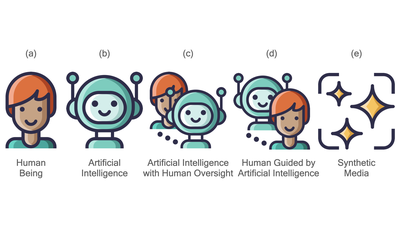
Botmark (IEEE 3152-2024)
I formed a working group to answer the challenge of not knowing the nature of entities with which one is interacting (human, AI, or some combination). The goal is to facilitate transparency, understanding, and trust during online, telephone, robotic, or other electronic interactions, thereby strengthening provisions for public safety and security. It is now a published standard, IEEE 3152-2024, on transparent human and machine agency identification.

Endohazard (IEEE 3173-2026)
Endocrine-disrupting chemicals can interfere with hormonal systems and are associated with reproductive, developmental, and other health risks. Endohazard provides a dedicated hazard symbol to improve awareness in products and business processes. It gives the hazard a recognisable mark, the way flammability and toxicity warnings do, so the risk travels with the product rather than living in a datasheet. The work is now the approved IEEE 3173-2026 standard.
Cultural projects

Cultural Peace
Social media is transforming our global society in powerful ways. The perception of increased social density has created a crucible of conflict where social interactions happen at vastly accelerated pace and scale. The CulturalPeace.org project aims to make and collect suggestions on how we can make fair, just, and impartial rules above conflict to preserve good faith and societal cohesion, and to help support a future détente between a multitude of memetic tribes.

Slana
Entheogenic medicines can loosen up emotional trauma in the brain and enable it to heal. They can undo conditioning that causes people to (re)act to perceived threats in an overly strong manner. They can also increase people's awareness and openness to understanding new perspectives, and to better understanding other people. Slana outlines the recent discoveries in this area, and posits these therapies as being particularly important for present and former conflict zones, such as Northern Ireland.

Pacha
Pacha aims to lead a conversation on the prospect of Automated Externality Accounting: the efficient and procedural detection, calculation, and prosecution of economic spillover effects such as pollution. From an analysis made by reasoning from first principles, I believe that this technology is an essential missing link in enabling a sustainable future for our planet.
Simulations & games

AI Guardians
An interactive visual novel that teaches AI ethics by putting the player inside a fictional AI lab, as ethicist, as safety wrangler, as one of several other roles, and making them live with their deployment decisions. Minigames cover red-teaming, corrigibility testing, and bias recognition, backed by a glossary of over 150 terms.
Ethics education that ships as play, rather than as a lecture. Currently in beta.

Founder Life
A narrative-driven life-simulator about the early-stage founder's journey: balance health, wealth, and happiness across five episodic chapters drawn from real entrepreneurial experience, and pick up resource management and startup discipline the hard way. It is autobiography as game design: the wins and the burnout both come from having been lived. Free to play on Steam.

MillOS
Browser-based 3D industrial simulation demonstrating agentic engineering partnership. A digital twin of a grain mill featuring autonomous workers, intelligent forklifts, real-time SCADA integration, and a Dual-Brain AI architecture. Built through dialogue with AI in place of a traditional development team.
USPs:
- 10 autonomous workers across 14 machines and 4 production zones
- 90 SCADA process tags with ISA-18.2 compliant alarms
- Dual-Brain AI (Gemini Pro strategic + Gemini Flash tactical)
- Bilateral Autonomy System with 5 control axes; WebRTC multiplayer
Systems & open source

Janus
Janus was the Roman god of doorways, and of looking two ways at once. This one is a bidirectional bridge for Windows kernel drivers: nineteen unmodified NT-era drivers (3.1 through XP) load and run inside a Windows 9x wrapper, and unmodified 9x drivers run on a real Windows 2000 kernel, with live hardware I/O and PCI bus enumeration actually working.
Its purpose is preservation and migration. A great many stranded systems (SCADA lines, medical imaging rigs, lab instruments, transit signalling) stay unpatchable for exactly one reason: a driver that nobody ever ported forward. Janus is a migration path across that gap, and it works in both directions. Open source.